31 Jan 2025
If you've ever needed to transfer money between Australian accounts, you've encountered a BSB code. Here's everything you need to know about how these six digit numbers work, where to find them, and how to avoid costly mistakes.
A BSB code is a six digit number used in Australia to route money to the correct bank and branch. Every domestic bank transfer in Australia requires one.
BSB stands for bank state branch. It identifies the bank or financial institution and the specific branch handling your account.
A BSB number is different from a bank account number. The BSB identifies the branch; the account number identifies your individual account.
To transfer money between Australian accounts, you always need both: the BSB and the bank account number. This applies to EFT, NPP payments, payroll, bill payments, and direct debits.
BSB codes are used solely for domestic transactions within Australia. For international transactions, you'll typically need a SWIFT/BIC code alongside the BSB and account number.
Here's a concrete example: to send money to an account at Commonwealth Bank in Sydney, you'd enter the six digit BSB (e.g. 062-000) plus the 8–9 digit account number. Without both pieces, the payment won't go through.
BSB stands for Bank State Branch. Think of it as the Australian equivalent of a sort code - a six digit code that tells the banking system exactly where to deliver your money.
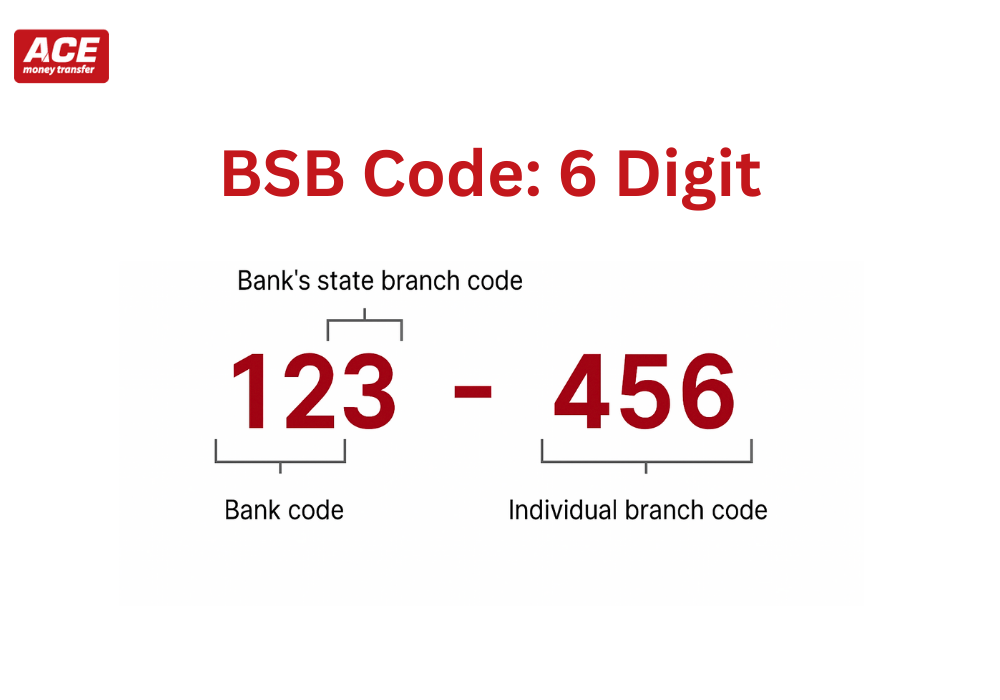
The format of a BSB code is XXY-ZZZ, broken down like this:
The first two digits identify the bank. For example, 06 is Commonwealth Bank, 08 is NAB, and 73 is ING.
The third digit indicates the state of the branch. In the original system, 2 means NSW or ACT, 3 means Victoria, 4 means Queensland, and so on.
The last three digits specify the branch's address - the specific branch or processing centre within that state.
A worked example: NAB BSB 082-902 breaks down as 08 (NAB), 2 (ACT/NSW), and 902 (Canberra City branch).
Modern electronic banking doesn't always rely on the state digit for routing decisions, but the six digit BSB format remains the standard across all Australian banks. Some online or neo-banks use a single BSB for all customers nationwide, meaning there's no physical branch location behind the last three digits.
Before the 1960s, Australian banking ran on manual branch ledgers and postal routing. If you wanted to send money across the country, your bank physically forwarded instructions branch-to-branch - slow and error-prone.
BSB codes were introduced in the early 1970s alongside MICR (Magnetic Ink Character Recognition) technology for cheque processing, giving every bank branch a machine-readable identifier.
Before BSB numbers, banks relied only on bank account numbers and branch ledgers, making national transfers slower and more error-prone.
The system became nationally standardised under what is now the Australian Payments Network (AusPayNet), which took over from the Australian Payments Clearing Association in 2017.
Through the 1980s and 1990s, BSB codes became critical as electronic fund transfers and salary direct deposits replaced paper-based cheques. BSB codes are used to automate payments like salary payments and direct debits, which would have been impossible at scale under the old manual system.
The 2000s brought online banking, and in 2018, the New Payments Platform (NPP) launched real-time transfers. NPP kept the BSB concept as the backbone but added PayID - letting you link a mobile number or email to your BSB and account. Although state-based numbering is now mostly historical, many banks still preserve old BSB ranges for continuity.
"BSB banking" simply means using BSB numbers alongside account numbers for Australian transactions. If you've ever paid a friend, received your salary, or set up a direct debit, you've used the system.
Typical scenarios where you need a BSB:
Paying a friend via online banking by entering their BSB number and bank account number.
Setting up payroll - your employer needs your BSB code and account number to deposit wages.
Arranging direct debits for utilities, rent, and subscriptions within Australia.
Here's how a basic domestic transfer works step-by-step:
You enter the recipient's BSB and account number.
Your bank validates the BSB to ensure it exists and matches a real bank branch.
The transaction routes through the Direct Entry system (BECS) or the NPP.
The receiving bank branch credits the recipient's account.
Banks verify the BSB to ensure correct fund routing. Without a valid BSB, the payment can't reach the correct branch, so the transaction will usually be rejected outright.
BSB codes ensure accurate routing of transactions in Australia across a wide range of everyday uses - salary payments, Centrelink deposits, mortgage repayments, and savings account transfers all depend on them. A BSB code is necessary for all domestic transactions in Australia.
A BSB number identifies the bank and branch. A bank account number uniquely identifies your individual account at that branch. BSB codes identify banks and branches, not individual accounts.
Here's the breakdown:
BSB (6 digits) = bank + state + branch (the bank state branch number)
Account number (typically 8–9 digits in Australia) = your personal or business account within that branch
To send money to Jane's account, you'd need: BSB 062-000, account number 12345678. The BSB narrows it down to Commonwealth Bank's Sydney processing centre; the account number pinpoints Jane's specific account. Together, they form the complete routing address.
A BSB code alone can't access or charge a specific account. It only identifies the branch or bank code, which is relevant if you're concerned about sharing details - giving someone your BSB and account is standard practice for receiving payments.
Common confusion points:
Customers sometimes mix up BSB and account numbers, or confuse their member number (common in credit unions) with their account number.
International forms may request a "routing code" or ask you to fill a national clearing code field - in Australia, this generally means your BSB.
When in doubt, the BSB is always the shorter six digit code, and the account number is the longer one (the next seven digits or more).
BSB codes are central to every domestic electronic payment in Australia and play a supporting role when money arrives from overseas.
For domestic transactions:
Direct Entry (bulk payments like payroll and bill payments) always requires BSB + account number for both debit and credit accounts. This system handles most salary, pension, and government benefit payments across Australian banks.
New Payments Platform (NPP) payments can use BSB + account or a PayID (e.g. email or mobile). The underlying system still stores a BSB-linked account - PayID is a convenience layer on top.
For international transfers into Australia:
Incoming transfers typically use a SWIFT/BIC code for the bank plus a Basic Bank Account Number (BBAN) made up of BSB and account number. BSB codes are part of the routing information for international transfers to Australia, along with SWIFT codes.
Fields labelled "National Clearing Code" or "Routing Code" should usually be filled with the six digit BSB for Australian bank accounts. BSB codes are required for receiving money from overseas along with the account number.
When sending money from Australia to other countries, you'll need the recipient's IBAN or local equivalent rather than a BSB number. Australia does not use IBANs in its domestic banking network.
Some providers format "pseudo-IBANs" by combining BSB codes and account numbers to fit overseas form requirements, but these aren't official. If a foreign form demands an IBAN for an Australian account, contact your bank for guidance on details information message help.
Losing or forgetting your BSB number is common and easy to fix. BSB codes aren't secret - they're safe to share whenever someone needs to send money to your Australian bank account.
Here's where to look:
You can find your BSB code in online banking or your mobile banking app. The account details screen usually shows BSB and account number together.
BSB codes are listed on bank statements, both paper and electronic.
Bank branch receipts, cheque books, or deposit slips for older accounts display the BSB in the MICR line.
You can look up BSB codes on bank websites using their branch locator or BSB search tools.
Visit bsb.auspaynet.com.au to find BSB codes. AusPayNet's public BSB directory lets you search by BSB, bank name, or branch details, and it's updated monthly.
If you're still unsure, call your bank branch to confirm your BSB code. Staff can read it directly from your account profile after verifying your identity.
Each Australian bank has known BSB prefixes - 06 for Commonwealth Bank, 08 for NAB, 01 for ANZ, 03 for Westpac. But you should still verify the exact digits rather than guessing, especially when the branch location matters. You can find bsb numbers through any of the methods above in under a minute.
Accurate BSB numbers matter. Every domestic payment in Australia - from rent to dividends - depends on the BSB and account pair being correct. BSB codes help identify specific bank branches across Australia, and getting them wrong creates real problems.
The most frequent uses:
Online banking transfers between Australian accounts
Salary, pension, and government benefit payments
Mortgage and personal loan repayments from your savings or transaction account
Direct debit arrangements for utilities, rent, and subscriptions
Business-to-business payments and batch payroll runs
What happens if you enter the wrong BSB:
The transaction may be rejected outright if the BSB doesn't exist.
The transfer may be sent to the wrong branch and possibly to the wrong account if other details line up. Incorrect BSB codes can lead to delayed or lost transactions.
You may need to request a trace or reversal through your bank, which can take several business days and is not always guaranteed.
Always double-check both BSB and account number before confirming, especially for large amounts or first-time payments.
Since mid-2025, Australian banks have been rolling out Confirmation of Payee - a system that checks whether the name you enter matches the account holder at the receiving bank. In its first year, the service was used over 150 million times, with thousands of risky transfers abandoned after users saw a "no match" warning. Your feedback helps banks improve these protections, and the answer to similar questions customers ask is always the same: verify before you send.

Many countries use similar routing systems, but formats and rules differ. You can't swap one for another when making an international payment.
BSB vs UK sort code:
Both are 6-digit routing codes used for domestic bank transfers.
Sort codes apply in the UK and Ireland; BSB codes apply in Australia only. A BSB is sometimes called an australian sort code, but the two are technically separate systems.
They can't be used interchangeably when sending money internationally.
BSB vs IBAN:
An IBAN (International Bank Account Number) is a longer, alphanumeric format used mainly in Europe and some other regions. IBANs are used for international transactions, unlike BSBs, which handle domestic routing.
Australia officially uses BSB + account number instead of a native IBAN. Sort codes are used in the UK, while BSBs are for Australia.
Some providers generate an IBAN-like number by combining BSB and account numbers for compatibility, but this is unofficial.
How New Zealand differs:
NZ uses a structure like XXXXXX YYYYYYY ZZZ that encodes bank, branch, account, and account type in a format where the first six numbers cover bank and branch details.
This serves a similar purpose to an Australian BSB plus account number pair, but the format is not called a BSB.
When making a money transfer internationally, always follow the local standard of the destination country. Use the sort code in the UK, IBAN in Europe, the BSB number in Australia, and the NZ format in New Zealand.
The Australian Payments Network (AusPayNet) maintains the BSB register. Every active australian bsb code in the system is issued and managed through AusPayNet, ensuring no two institutions share the same code.
AusPayNet issues and manages unique BSB numbers for licensed banks, building societies, and credit unions - any financial institution participating in Australia's clearing systems.
BSB ranges are allocated to major banks. The Big Four historically received low-number prefixes: 01 for ANZ, 03 for Westpac, 06 for Commonwealth Bank, 08 for NAB. Regional banks and mutuals get distinct ranges (e.g. 63x or 80x for credit unions).
Some smaller institutions use an intermediary bank's BSB range to access clearing services, which is why you might see an unexpected prefix on a smaller bank's account.
The historical state-based structure:
Many large Australian banks once used the third digit code to indicate state (e.g. 2 for NSW, 3 for Victoria, 5 for SA/NT).
This scheme is now mostly historical and has less practical impact for modern electronic banking, but still appears in older BSB lists and is preserved by preference at most major banks.
Some banks have moved toward "universal" BSB numbers not tied to a physical branch, especially for online-only savings and transaction products. Keeping BSB allocation centralised helps maintain consistent routing, easier BSB lookup, and fewer conflicts between institutions.
Providing complete and accurate details is essential when sending money to an Australian bank account. Use this checklist every time - it takes thirty seconds and can save you days of chasing misdirected funds.
Information to gather before sending:
Recipient's full name as it appears on their bank account
Recipient's BSB number (6 digits, the bank state branch code in digit code format)
Recipient's bank account number (typically 8–9 digits; note the last three numbers may differ between savings and transaction accounts)
Bank name (e.g. ANZ, NAB, Westpac) and branch name or suburb if known
Payment reference or description so the receiver can identify the transaction
For international transfers to Australia, you may also need:
The bank's SWIFT/BIC code
The bank's address or city
Sometimes the BSB entered in a national clearing code field instead of IBAN
When using new BSB and account details for the first time - especially from overseas - send a low-value test payment first to confirm everything routes correctly.
To transfer money between Australian accounts, both the BSB and the account number are required. Understanding how BSB numbers and bank account numbers work together is the simplest way to make safer, faster payments in and to Australia. Before your next transfer, run through this checklist - your future self will thank you.